Industry Report

Revenera Monetization Monitor Software and AI Pricing
Models and Strategies
2027

What 415 established technology companies reveal about software and AI pricing, adoption, and profitability.

Thank you for registering—enjoy the full report
decorative image

THE QUIET MAJORITY: AI Monetization Beyond the Headlines

Media attention is dominated by a handful of AI-native startups and Big Tech powerhouses whose rapid innovations are shaping expectations for AI success.

But for the Quiet Majority of established software producers, the AI revolution is playing out at a different pace. They are introducing AI capabilities across broad portfolios spanning on-premises, Saas, and embedded software, building on existing products and pricing models while experimenting with new ones.

I expect we are nowhere near the end of shifts to monetization due to AI integration. Remaining flexible will be key.”

Director of marketing/sales A software/SaaS company with $101-$250 million USD annual revenue

This report is based on a survey of 415 leaders from global software producers, including intelligent device1 manufacturers whose products contain software. Their challenge is to integrate AI into what already works, determine where it creates value, and find ways to monetize it without disrupting their business.

The findings reveal a market still finding its feet, where innovation is balanced against customer adoption, pricing uncertainty, profitability pressures, and the need for better insight into how products are actually being used.

1 Intelligent device products include industrial automation, network and telecommunications, IoT, and medical devices.

Nicole Segerer

Nicole Segerer
SVP & General Manager,
Revenera

The next phase of AI adoption will hinge on getting the commercial foundations right. Better usage insight will help producers understand where customers find value, how they use AI, and how to price it in ways that encourage adoption while protecting profitability.”

Key Takeaways

icon

AI features are widespread, but customer adoption is lagging.
96% of respondents have added AI capabilities to their products, yet almost half (48%) report limited or low customer adoption. Building AI may have been the easy part. The next challenge is proving its value and getting customers to use it.

icon

AI is generating growth, but delivery costs erode margins.
69% believe their AI offerings drive revenue growth, with 52% also reporting improved profitability. However, 41% say the cost of providing AI is squeezing margins. Separately, increased AI delivery costs (47%), increased cloud costs (43%), and the inability to offer new monetization models (37%) were identified as the biggest threats to future growth.

icon

The customer insight gap is making AI harder to price.
The biggest blockers to price and value alignment are “data availability and insights” and “understanding customer value drivers,” each cited by 49%. Better usage intelligence can help close both gaps, providing a clearer view of how customers use products, where they find value, and what they may be willing to pay.

icon

Predictability is winning over revenue maximization.
With customers wary of unpredictable AI costs, companies are almost 3x more likely to prioritize pricing predictability over near-term revenue maximization (47% vs. 16%). Higher-priced subscription tiers, AI included at no additional cost, and hybrid subscription + usage/outcome models are most common, giving customers greater cost certainty.

icon

Pricing pressure is emerging, but seat loss remains limited.
While 45% report downward pricing pressure due to AI, just 7% have experienced customer seat loss to date. Churn may be limited for now, but the picture could change as AI adoption grows and customers reassess the value they are getting from their software.

icon

Usage data is a goldmine, but many are still digging by hand.
Despite its potential to inform product, pricing, and retention decisions, usage data remains difficult to harness. 41% still rely on manual processes or engineering effort to collect it, while only 27% use automated alerts to identify churn risk.

Contents

Methodology & Demographics

Methodology

The survey was conducted in June and July of 2026. Survey invitations were sent to Revenera’s marketing database as well as a vetted third-party panel. Only 8% of respondents are Revenera customers. Results are based on insights from 415 participants, while some questions were asked to a subset of more qualified respondents.

Demographics

All respondents are well-established producers with significant revenue streams from a mix of on-premises, SaaS, and embedded software.

  • 69% are software/SaaS companies, while 31% represent intelligent products, including industrial equipment, networking and telecommunications, IoT, and medical devices.
  • 66% generate more than $100M USD in revenue.
  • 75% have at least 10 software products, with 33% managing portfolios of more than 50 products.
  • They use an average of four monetization models, reflecting the complexity of monetizing established product portfolios.
  • Respondents span IT, product management, engineering, IoT strategy, operations, and marketing/sales, with 68% at director level or above.
  • Company sizes range from small businesses to global enterprises, with 33% employing 1,000–5,000 people and 16% employing more than 10,000.

Industry of Respondents

N=415
Source: 2027 Revenera Monetization Monitor Survey

View

Revenue of Respondents

N=415
Source: 2027 Revenera Monetization Monitor Survey

View

Number of Products Containing Software

N=404
Source: 2027 Revenera Monetization Monitor Survey

View

Types of Software Delivered by Respondents

N=415
Source: 2027 Revenera Monetization Monitor Survey

View

Role of Respondents

N=415
Source: 2027 Revenera Monetization Monitor Survey

View

Job Function of Respondents

N=415
Source: 2027 Revenera Monetization Monitor Survey

View

Reuse

We encourage the reuse of data, charts and text published in this report under the terms of this Creative Commons Attribution 4.0 International License. You’re free to share and make commercial use of this work as long as you provide attribution to the Revenera Monetization Monitor: Software and AI Pricing Models and Strategies 2027 report as stipulated in the terms of the license.

AI Adoption: Everyone is building AI. Not everyone is using it.

How many software providers offer AI today?

96% of respondents have added AI capabilities to at least some of their products, up from 80% last year. The remaining 4% plan to offer AI within the next 18 months.

Availability of AI capabilities

N=408
Source: 2027 Revenera Monetization Monitor Survey

View

61% say most or all their products contain AI features. 16% include AI in all products, 45% include AI in most (more than half) of their products, and 35% include AI in some (less than half) of their products.

Proportion of products containing AI

N=380
Source: 2027 Revenera Monetization Monitor Survey

View

What types of AI features are software providers including?

The most common use case for AI is providing predictive or analytical insights (70%). A cluster of other types of AI are offered by around half of respondents: workflow automation and process execution (56%), Generative AI (55%), and agentic AI (48%).

Types of AI offered today

N=380
Source: 2027 Revenera Monetization Monitor Survey

View

What is the adoption of AI features?

Adoption is a significant challenge, with almost half (48%) reporting limited or low user adoption levels2. One-third report moderate adoption. Only about 1 in 10 respondents (11%) report high adoption of their AI features.

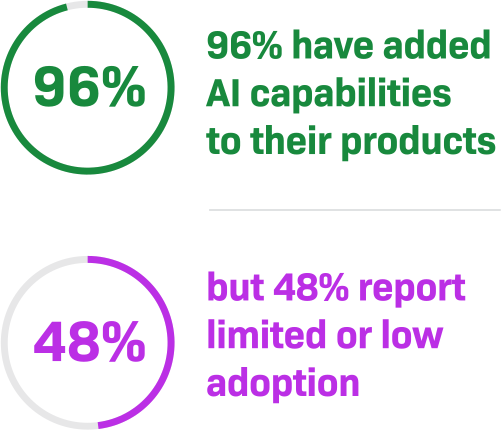
96% have added AI capabilities to their products but 48% report limited or low adoption

Adoption of AI features

N=380
Source: 2027 Revenera Monetization Monitor Survey

View

2 Based on percentage of eligible users actively using AI features: limited = <25%, low = 25–49%, moderate = 50–75%, high = >75%.

AI Pricing Models: It’s not just about usage-based pricing

While consumption-based and outcome-based pricing are often positioned as the preferred models for AI and agentic capabilities, the Quiet Majority is at an earlier stage of its monetization journey, taking a more cautious approach.

What are today’s top pricing models for AI?

The most common strategies for monetizing AI are to include AI features in a higher-priced tier (40%), to include AI capabilities within an existing product at “no extra cost” (39%), and as a hybrid offering (subscription + usage/ outcome) (37%). Each of these helps provide predictable pricing to customers.

Today’s AI monetization Strategies

N=90
Source: 2027 Revenera Monetization Monitor Survey

View

Balancing high API compute costs for AI features with a predictable subscription price that users find fair is a tricky puzzle right now.”

Director of Product Management Software/SaaS company with $250M–$1B USD annual revenue

How is revenue balanced with pricing predictability?

Respondents are nearly three times more likely to prioritize pricing predictability for customers over revenue maximization (47% vs. 16%). More than one-third (37%) report taking a balanced approach between revenue maximization vs. pricing predictability.

Maximizing revenue vs. pricing predictability for customers

N=415
Source: 2027 Revenera Monetization Monitor Survey

View